

Maths
Maths Overview




Maths Knowledge Organisers


Maths Curriculum
Intent Statement: What We Aim For
At Oaklands, we want every child to:
- Feel confident with numbers and use them fluently.
- Think and talk like mathematicians, explaining their ideas clearly.
- Solve problems by breaking them down and trying different approaches.
- Understand maths deeply, so they can use it in real life and across other subjects.
We believe all children can succeed in maths. Teachers model good practice and adapt their teaching to suit different learning styles, whether children learn best by seeing, describing, or experimenting. We also focus on building a rich maths vocabulary so children can talk about their learning and make connections.
Implementation – How We Teach Maths
We follow the White Rose Maths scheme, which is based on the National Curriculum. Teachers personalise lessons to meet the needs of their class while ensuring key skills are taught. We also use resources like NCETM and NRICH to make learning exciting and challenging.
Children learn through a Concrete, Pictorial, Abstract approach:
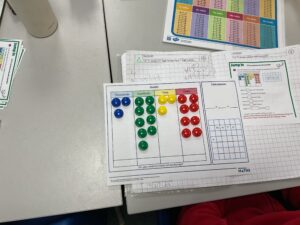
- Concrete: Using objects like Numicon and counters.
- Pictorial: Using diagrams and drawings.
- Abstract: Using numbers and symbols once they understand the concept.
We use Times Tables Rock Stars to help children practise multiplication both in school and at home. Children take part in fun competitions and challenges to boost their confidence.
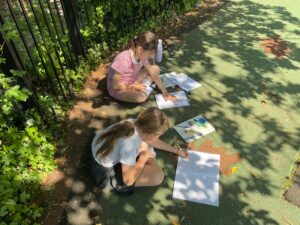
Maths is taught across the curriculum, and events like Maths Week help children apply their skills in different contexts.
Teachers regularly assess children’s progress and use this information to plan lessons, support learning, and share updates with parents.



Impact – What Children Achieve
Children at Oaklands enjoy maths and talk positively about their learning. They:
- Understand how maths is used in everyday life and future jobs.
- Feel confident trying new challenges and choosing tasks that suit their level.
- Use maths vocabulary to explain their thinking.
- Show resilience and pride in their work.
- Make connections between different areas of maths.
By the end of each year, most children meet the Age Related Expectations (ARE) for their year group. Some go further and achieve Greater Depth (GD). If children need extra help, we provide support to help them catch up and succeed.
Progression– How Children Move Forward
All children work on the same core tasks, which include:
- Fluency – practising key skills (Jump In)
- Reasoning – explaining their thinking (Dive Deeper)
- Problem-solving – applying their knowledge (Go Beyond)
Children who grasp concepts quickly move on to stretch and challenge tasks, such as investigations and deeper reasoning questions. Those who need more support receive targeted help.
Skills and knowledge are revisited throughout the year in different contexts, helping children build a strong understanding and make progress.

Maths Policy
Multiplication &
Division Policy
Addition &
Subtraction Policy


